How to tie the Bowline
The bowline makes a fixed loop at the end of a rope that will not slip or tighten under load and is easy to untie afterwards. It is quick to tie, but it can work loose when the rope goes slack.
- Type
- Loop knots
- Difficulty
- Easy
- ABOK number
- #1010
- Also known as
- Bowline knot, Boling knot (archaic), King of the knots
- Best for
- Sailing and boating, Camping, General rope work
The bowline (usually pronounced BOH-lin) is one of the oldest and best-known knots there is. It was recorded as the "Boling knot" in John Smith's A Sea Grammar in 1627, and it is often called the "king of the knots" because it is so widely useful.[1]
Its appeal is simple: the loop stays the size you made it, the knot does not jam, and it comes apart easily once the load is off. The trade-off is security. A bowline that is slack, shaken or loaded in the wrong direction can loosen, so it is worth knowing when to back it up and when to pick a different knot.[2]
Step-by-step: tying the Bowline
-
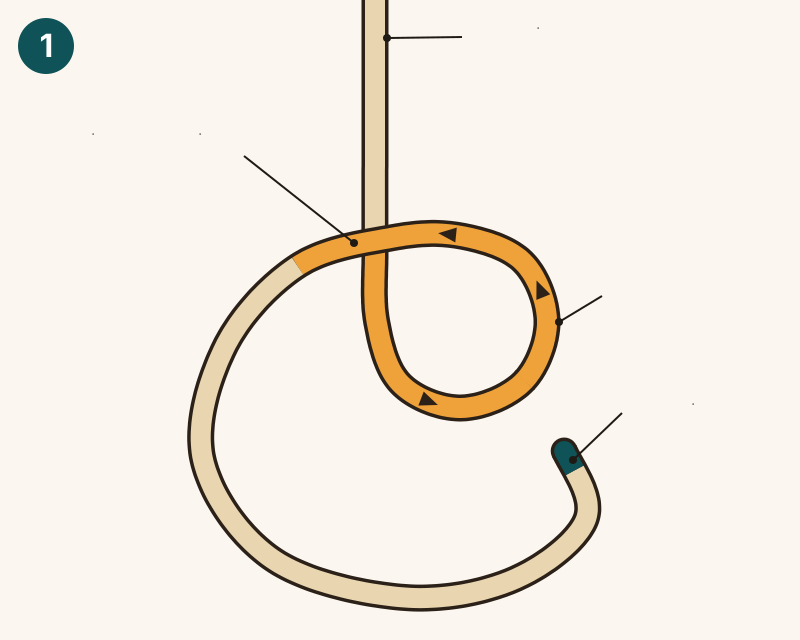
Step 1: Make a small loop in the standing part
Lay the rope out with the working end towards you, leaving enough rope beyond this point for the size of loop you want. Twist a small loop into the standing part so that the side leading to the working end crosses on top. This small loop is the "hole" in the rabbit rhyme.
-
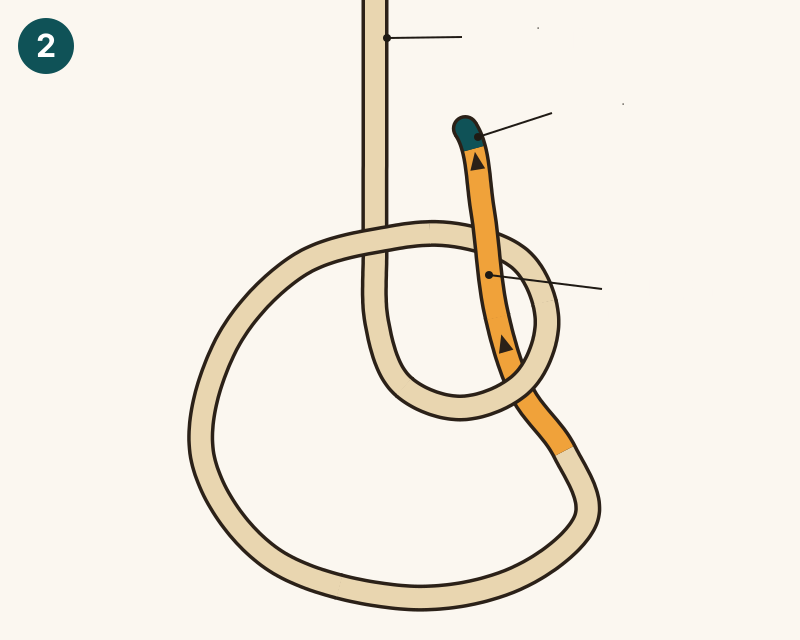
Step 2: Bring the working end up through the loop
Pass the working end up through the small loop from underneath. The rabbit comes out of the hole. The rope you have just swept round becomes the big loop of the finished knot.
-
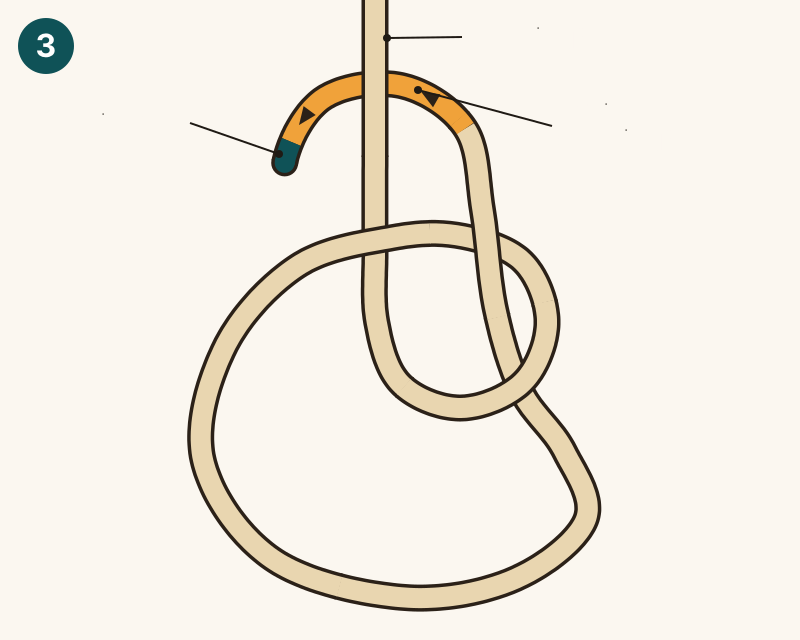
Step 3: Go around behind the standing part
Carry the working end behind the standing part and bring it round to the other side. The rabbit runs round the tree. Leave this turn loose for now.
-
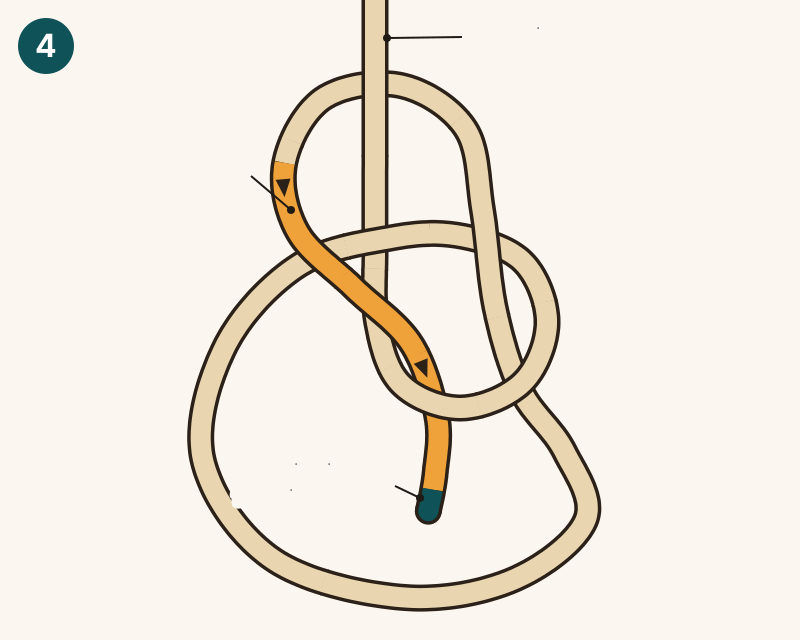
Step 4: Go back down through the small loop
Feed the working end back down through the small loop, alongside the strand that came up in step 2. The rabbit goes back down the hole. The end should finish inside the big loop, lying next to one of its legs.
-
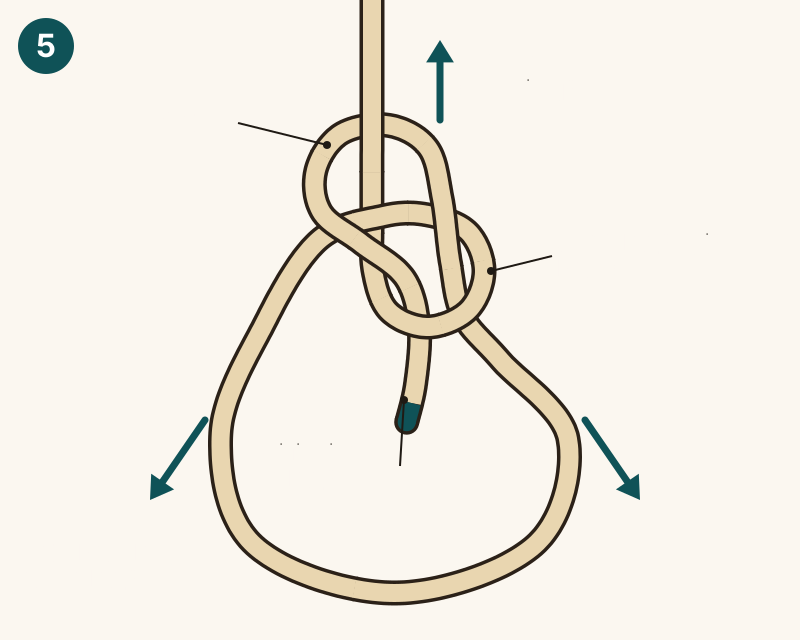
Step 5: Dress and tighten
Hold both legs of the big loop (the tail and the leg beside it) in one hand and pull the standing part with the other. The small loop closes and grips both strands, and the turn around the standing part settles into a neat collar. Check that the tail is inside the loop and leave it generously long.
What the Bowline is used for
- Making a fixed loop at the end of a line to drop over a post, cleat or bollard, or to tie to a ring, such as a mooring line.[2]
- Sailing jobs such as attaching sheets to the clew of a headsail and securing halyards.[1]
- Tying a rope around an object, tree or anchor point when you want a loop that will not close up and squeeze it.
- Joining two ropes by linking a bowline in the end of each one.[2]
- Tying down light aircraft: it is the knot the US Federal Aviation Administration recommends for that job.[1]
- General camp and household use: hanging a bear bag or food bag, fixing a ridgeline to a tree, making a handle or towing loop.
Strengths and weaknesses
Strengths
- The loop is fixed: it does not slip or close up under load.[2]
- It does not jam, so it is easy to untie even after holding a heavy load.[1]
- Fast to tie once learned, and it can be tied with one hand.[2]
- Easy to inspect: a correct bowline has a recognisable collar and a tail lying inside the loop.
- Uses little rope and can be tied around or through an object, unlike a loop tied on a bight.
Weaknesses
- It can shake or work loose when it is not under load, or when the load comes on and off repeatedly. This is more likely in stiff or slippery rope.[1][2]
- It can slip or deform if the loop itself is pulled apart sideways (ring loading) instead of being loaded along the standing part.[1]
- It cannot be tied or untied while there is load on the standing part, so it is a poor choice where you may need to release a line under tension.[2]
- It is easy to tie a wrong version that looks similar at a glance, so it needs checking every time.[2]
- For anything critical it needs a backup, such as a stopper knot tied with the tail or a Yosemite finish.[2]
Tips and common mistakes
Tips
- Remember the rhyme: the rabbit comes up out of the hole, runs round the tree, and goes back down the hole.
- Set the loop size before you start by choosing where on the rope you make the small loop.
- Leave a long tail. A short tail is the first thing to pull through if the knot starts to loosen.
- To untie, push the collar away from the loop along the standing part ("breaking the back" of the knot). The small loop then loosens and the knot falls apart.
- If the rope will be slack or shaken for long periods, tie a stopper knot with the tail around the adjacent leg of the loop, or choose a more secure variation.[2]
- If you add a Yosemite finish, tighten the bowline first. Tightened in the wrong order, the knot can turn into a slip knot.[2]
Common mistakes
- Small loop twisted the wrong way. If the standing part is on top in step 1, the working end will not lock and the knot falls apart or forms a slip knot when pulled.
- Going around the tree the wrong way. This leaves the tail on the outside of the loop: the left-handed or "cowboy" bowline. It holds, but it is a different knot and the tail is more likely to snag.[2]
- Coming down through the wrong opening. The end must go back through the small loop, not through the big loop.
- Not dressing the knot. A loose, sloppy bowline is more likely to capsize or shake free. Snug it down before trusting it.
- Tail too short.
- Loading the loop sideways. Pulling the two legs of the loop apart, as when a loop is clipped and loaded across its width, is the direction the bowline handles worst.[1]
Variations
- Double bowline (round turn bowline) — The small loop is made with two turns instead of one, which grips the tail more firmly.[1]
- Yosemite bowline — A bowline whose tail is wrapped around a leg of the loop and tucked back up alongside the standing part. Common among climbers.[1]
- Water bowline — Starts from a clove hitch in the standing part rather than a single loop.[1]
- Left-handed (cowboy) bowline — The tail finishes outside the loop. It copes better with a loop pulled apart sideways, but the exposed tail can catch.[2]
- Eskimo bowline — Tied around a leg of the loop instead of the standing part. Suited to loops that will be stretched wide.[2]
- Running bowline — A bowline tied around its own standing part to make a noose that slides.[1]
- Bowline on a bight — Makes a pair of fixed loops in the middle of a rope without needing access to an end.
Related knots
- Sheet bend — Has the same structure as the bowline, but joins two ropes instead of forming a loop.[1]
- Figure-eight follow-through — A bulkier fixed loop that is harder to untie after loading but more secure, and the usual climbing tie-in knot.
- Figure-eight loop — A fixed loop tied on a bight, for when you do not need to thread the rope around something.
- Alpine butterfly loop — A fixed loop for the middle of a rope.
- Clove hitch — A quick, adjustable way to fasten a rope to a post when you do not need a loop.
Frequently asked questions
What is a bowline knot used for?
It makes a fixed loop at the end of a rope. Typical jobs are mooring a boat to a ring or post, attaching sheets to a sail, tying a line around a tree, and any task where you want a loop that will not tighten and that you can untie easily later.[2]
Is the bowline a safe knot?
It is reliable while it is under steady load along the standing part. Its weakness is that it can loosen when slack, shaken or loaded sideways across the loop. For everyday tasks that is rarely a problem. For anything where failure could hurt someone, back it up or use a more secure knot.[1]
Can I use a bowline for climbing?
Some experienced climbers tie in with a bowline variation plus a backup because it is easy to untie after a fall. A plain bowline with no backup is not considered adequate, and many gyms and courses require the figure-eight follow-through. Learn tie-in knots in person from a qualified instructor.[2]
How do you untie a bowline that has been pulled tight?
Take the load off, then bend the collar back along the standing part, away from the loop. That frees the small loop and the rest of the knot loosens. You cannot untie a bowline while the standing part is still under load.[2]
Why did my bowline come undone?
The usual causes are a short tail, a knot that was never snugged down, stiff or slippery rope, and a line that was slack and flapping for a while. Dress the knot firmly, leave a long tail, and add a stopper knot with the tail if the rope will spend time unloaded.[2]
How long should the tail be?
Long enough that it cannot pull back through if the knot shifts. Some texts suggest about twelve times the rope's circumference, which is longer than most people leave in practice. If in doubt, leave more and secure it with a stopper knot.[2]
Sources
- Bowline – Wikipedia — history, ABOK reference, security issues and variations
- Bowline Knot – Animated Knots by Grog — uses, advantages, disadvantages and safety-knot advice
- Clifford W. Ashley, The Ashley Book of Knots (1944), entry #1010 — standard reference numbering for the bowline
Last reviewed: