How to tie the Prusik hitch
The Prusik attaches a cord loop to a larger rope. It can slide when unloaded and grips when the loop is pulled. Its symmetrical wraps let it grip in either direction along the rope.
- Type
- Hitches
- Difficulty
- Moderate
- ABOK number
- #1763
- Also known as
- Prusik knot, Triple sliding hitch
- Best for
- Climbing, Rescue
A Prusik is a friction hitch, not a fixed attachment knot. Climbers and rescuers use it in rope-ascent and hauling systems that require separate training.[2][1]
These diagrams show three passes of a closed loop, giving three coils on each side of the central bridge. The right cord and wrap count depend on the main rope; three passes are not a guarantee of grip.[3]
Ashley’s entry #1763 describes the same structure for hoisting a spar, without the modern name or its slide-and-grip application.[1]
Step-by-step: tying the Prusik hitch
-
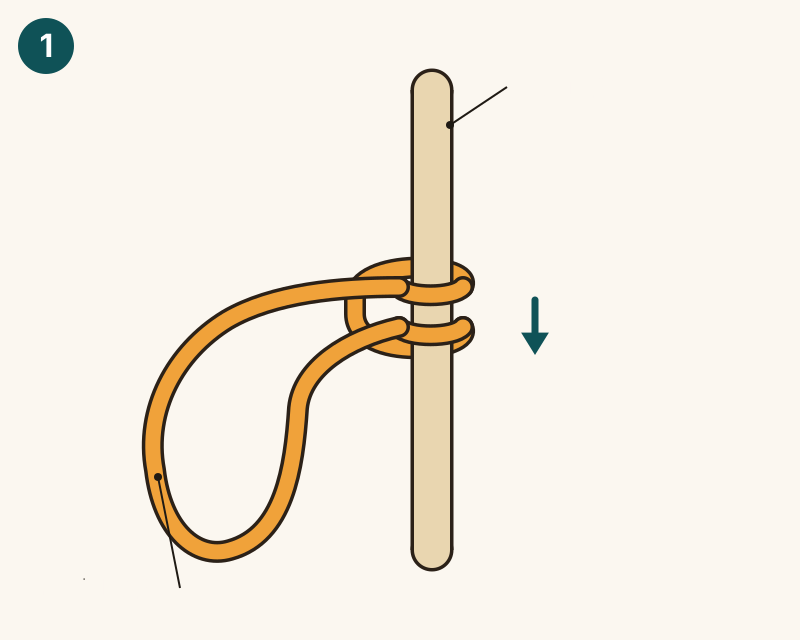
Step 1: Make the first pass
Place the cord loop behind the main rope. Pass the long side of the loop around the rope and through the short bight. This makes the first girth-hitch-like turn. Keep any joining knot away from the wraps.
-
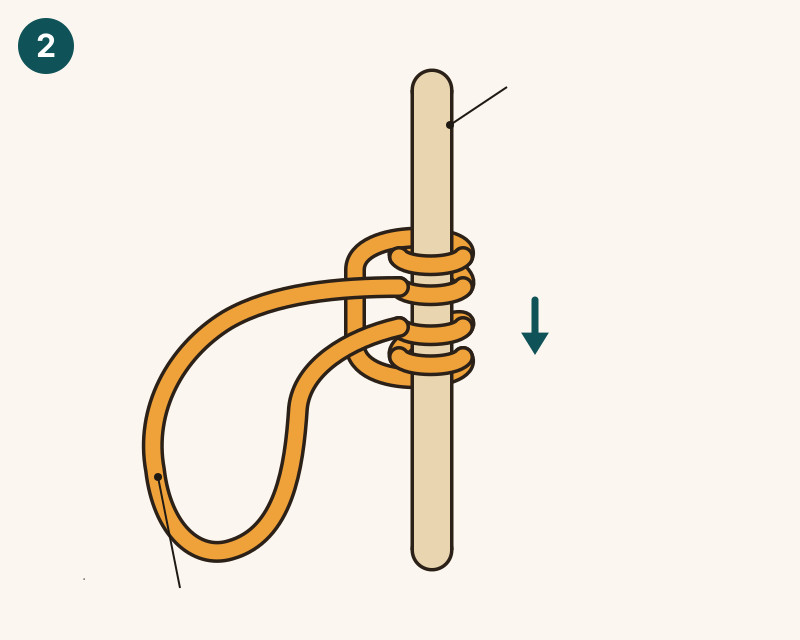
Step 2: Pass through again
Carry the long loop around the main rope once more and pass it through the same short bight. Lay the new turns inside the first pair rather than across them.
-
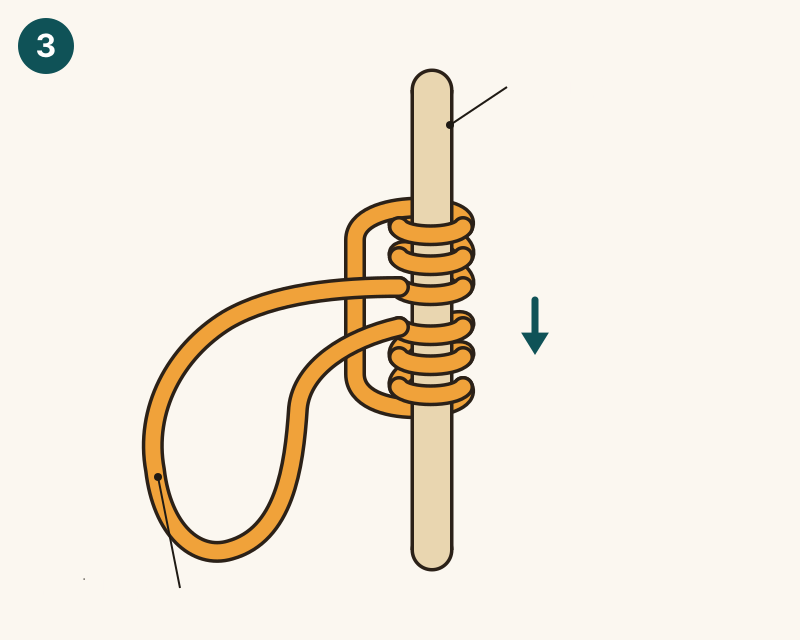
Step 3: Add the third pass
Repeat once more through the same bight. You should now have three coils above and three below the point where the long loop exits. Keep all coils parallel.
-
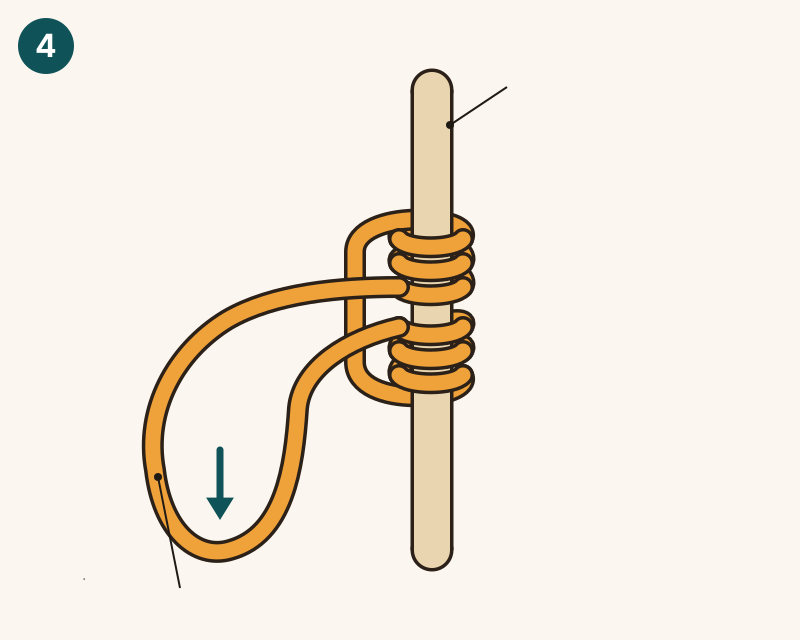
Step 4: Dress and test the grip
Snug the three coils on each side together without overlaps or crossed strands, keeping both loop strands exiting from the middle through the short bight. Pull the Prusik loop downward to set the hitch. In a safe practice setup, check that it grips in the intended directions and slides only after you remove the load and loosen it.
What the Prusik hitch is used for
Strengths and weaknesses
Tips and common mistakes
Tips
- Start with a properly made closed cord loop. These drawings omit its joining knot so the wrap path stays visible.
- Unload the hitch before trying to move it.
Common mistakes
Variations
- Schwabisch hitch — An asymmetrical friction-hitch variation.[1]
Related knots
Frequently asked questions
Does a Prusik grip in both directions?
Yes. Its symmetrical construction can lock in either direction along the rope.[3]
How many wraps should I use?
The example uses three passes. Select the actual count for your rope and cord using the manufacturers’ guidance and supervised practice.[3]
Can I use webbing instead of cord?
Use suitable cord for this traditional Prusik. The AMC handbook distinguishes it from hitches such as the Klemheist that can also use webbing.[4]
Why is it hard to move?
The hitch tightens under load. Remove the load before loosening it; a weighted Prusik can be hard to release.[4]
Sources
- Prusik Knot — Animated Knots by Grog — three-pass construction, uses and ABOK #1763
- Prusik — Wikipedia — friction-hitch terminology and related hitches
- Friction hitches — Petzl — cord compatibility, wrap count, bidirectional grip and training
- 2025 Program Handbook — AMC Boston Climbers — Prusik construction, parallel wraps, cord and difficulty releasing after loading
Last reviewed: