How to tie the Square knot
The square knot binds the ends of a cord around a bundle. It is quick to tie, but can spill or slip and must never join ropes for load-bearing or life-safety use.
- Type
- Binding knots
- Difficulty
- Easy
- ABOK number
- #1402
- Also known as
- Reef knot
- Best for
- General rope work, Camping
Two half-knots tied in opposite directions make a square knot. Repeating the same direction makes a granny knot.[2]
Use it to bind something, not as a general rope join.[3]
Step-by-step: tying the Square knot
-
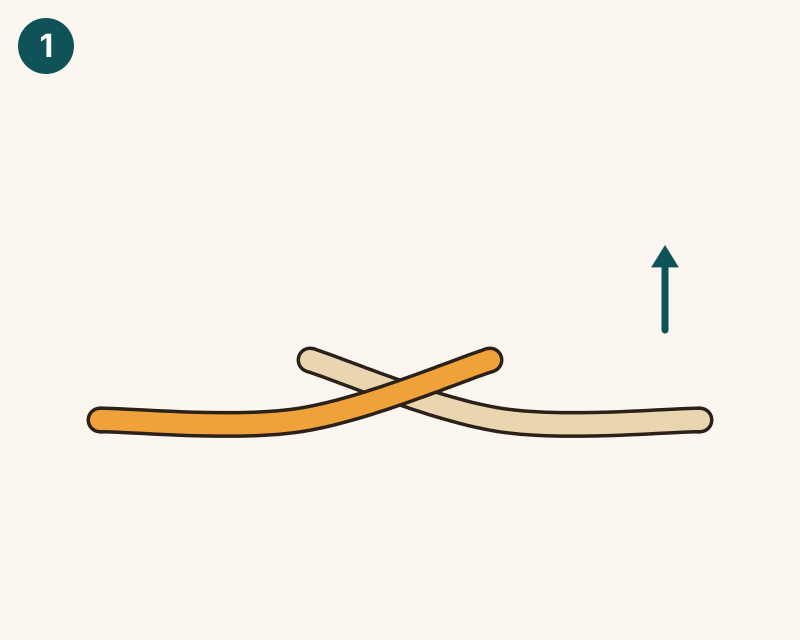
Step 1: Cross left over right
Bring the cord around the bundle. Cross the orange left end over the tan right end. Follow the same colors throughout.
-
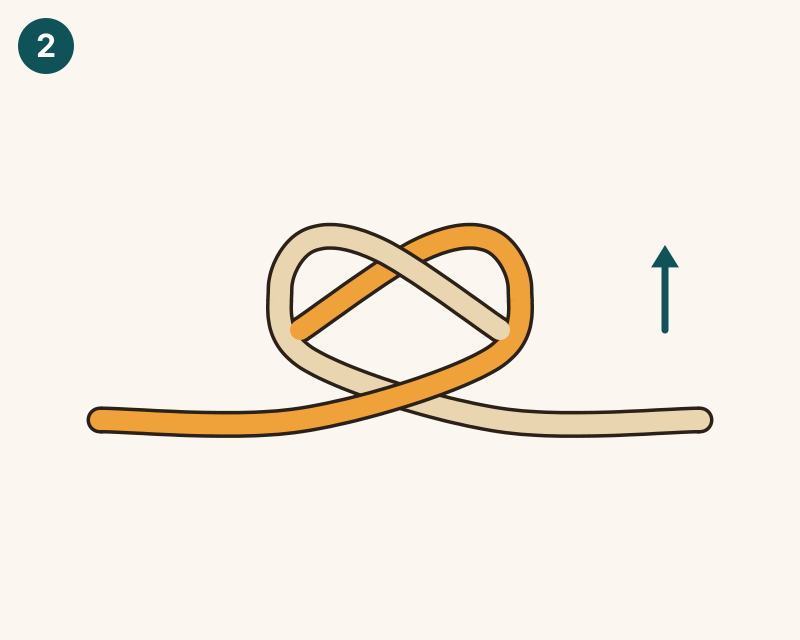
Step 2: Complete the first half-knot
Tuck the orange end under and around the tan end to complete the first half-knot. The orange end is now on the left of this open view and the tan end on the right.
-
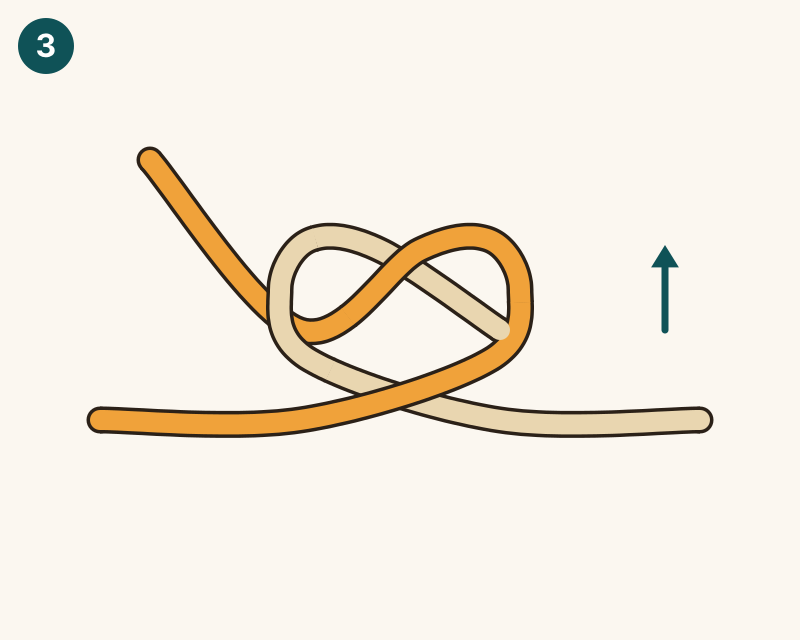
Step 3: Cross right over left
Cross the end now on the right over the end on the left: tan over orange. This reverses the first half-knot.
-
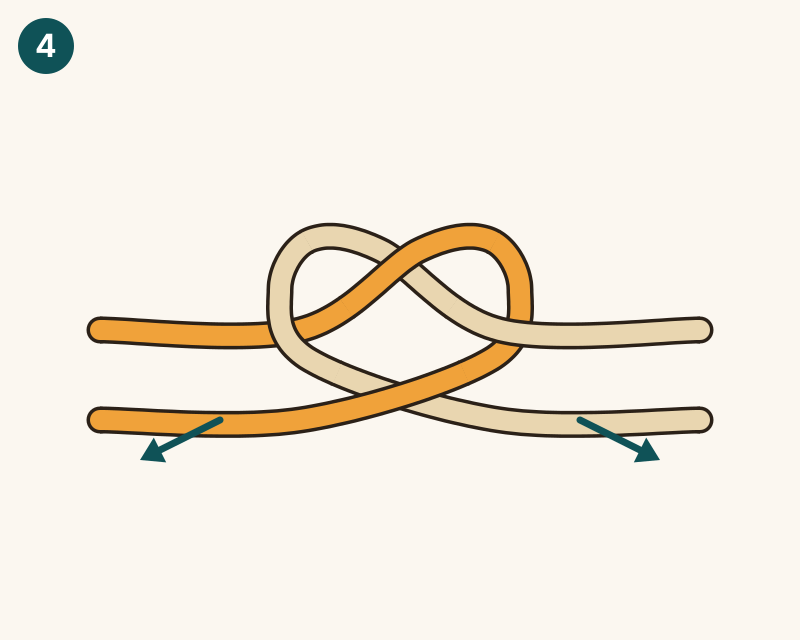
Step 4: Tuck and pull
Tuck under to complete the opposite half-knot, then pull both pairs apart. Each bight’s tail and standing part must exit together on the same side, parallel to each other. The knot is spread open so you can trace both interlocking bights.
What the Square knot is used for
Strengths and weaknesses
Tips and common mistakes
Tips
- Say “left over right, right over left.”[3]
- Check that each tail exits beside its own standing part.[3]
Common mistakes
Variations
Related knots
- Sheet bend — A bend for joining two ropes.[3]
- Overhand knot — Learn the simple overhand structure.
- Bowline — Makes a fixed loop rather than a binding knot.
Frequently asked questions
Is a reef knot the same as a square knot?
Yes. Both names describe this binding knot.[3]
Can it join two ropes?
Do not use it as a rope join. It can spill apart; choose an appropriate bend.[3]
How is a granny knot different?
Its two half-knots have the same handedness instead of opposing handedness.[2]
What is it good for?
Non-critical binding, such as string around a parcel or a sail cover.[1]
Sources
- Square knot — Animated Knots by Grog — tying sequence, uses and cautions
- Reef knot — Wikipedia — structure, limitations and Ashley numbering
- Square knot — NetKnots — instructions and checks
Last reviewed: